IMAGO DEI
Process… from the solitude of the studio… energized by joy in the design, the designer and the community of artists around me...
Blog : Imago Dei
As with most artists, I love the aloneness of the studio. That said, I have learned to love my art community—understanding local artists, affirming their work, giving and receiving suggestions, and growing as I allow them into my process.
In Asian traditions, spirituality and art share a similar and sometimes overlapping space. The concept of Imago Dei, the belief that mankind’s art naturally unfolds as an imprint of a creator God, motivates and encourages me as I paint. Because he is a maker, human beings make…
The Edge Lived
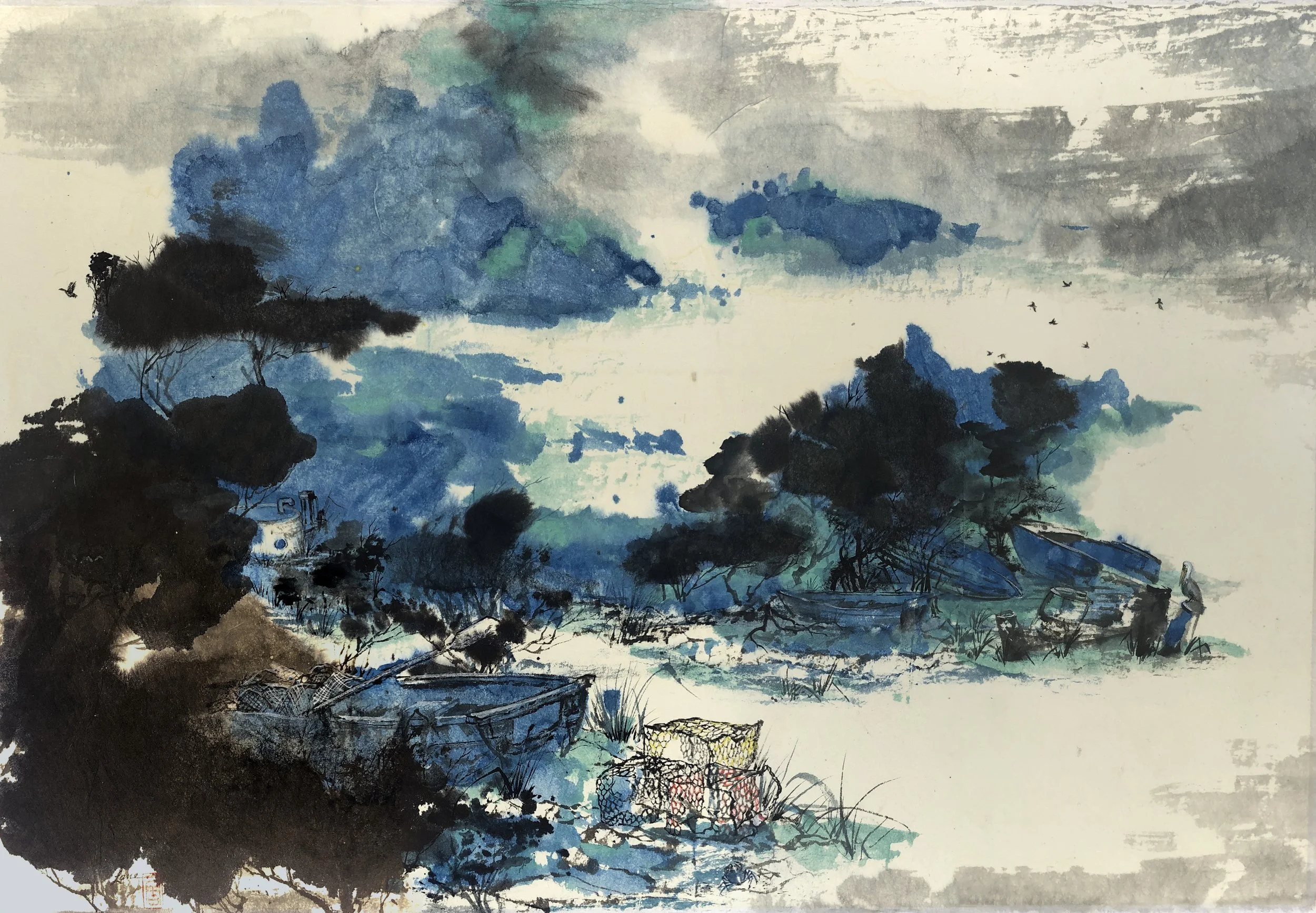
“The Edge Lived” developed as “splashed ink and color” expression after the style of the famed sumi-e artist, Zhang Daqian. The ink and phthalein blue presented a number of sobering if not dark opportunities for brushwork development. As I meditated on the flow of ink and pigment boats began to appear and a shoreline and a scene came into focus from the life of those who live at the edge of Carolina fisheries. They are courageous folk with a history. Sometime the stories are told between the laughter over a supper of fried speckled trout, but sometimes the narratives emerge as discarded and wornout watercraft, piles of rope, torn nets telling the story of struggles to make a living along the mudflats and family dockyards. My favorite part of the painting is the crabpots— owners identified by the colors woven into their wire mesh. The most “message heavy” element is the small sewage pumping station that speaks to the need for supportive infrastructure from government agencies. Welcome to “the edge lived,” a somber place of memory and investment of the lives lived by commercial fishing families along the coast of NC.
Neighborhood Renewal
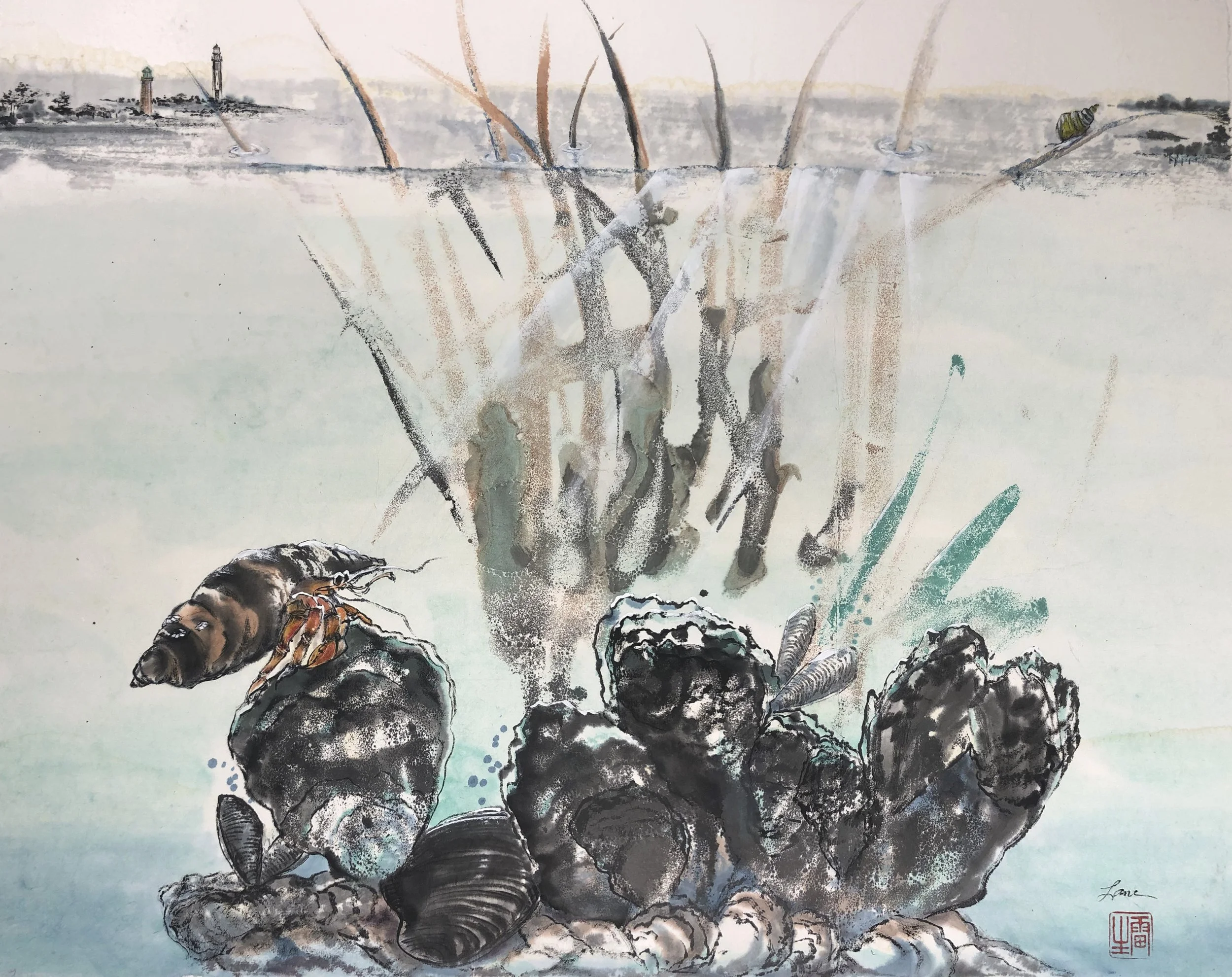
This piece celebrates hope for the shallows of the Lynnhaven estuary. I loved the process as the pour rendered up shallow water grasses and an oyster bed. In addition to being a great food source, oysters improve the environment. So let’s root for oysters and support renewal of oyster beds. I knew about the amazing filtering capacity of one oyster— 50 gallons of water a day and about how they consume nitrogen pollutants but what I didn’t know was that excess algae is “packaged up” and left on the bottom as harmless waste…Amazing stuff…amazing design.
“Living With the Land”
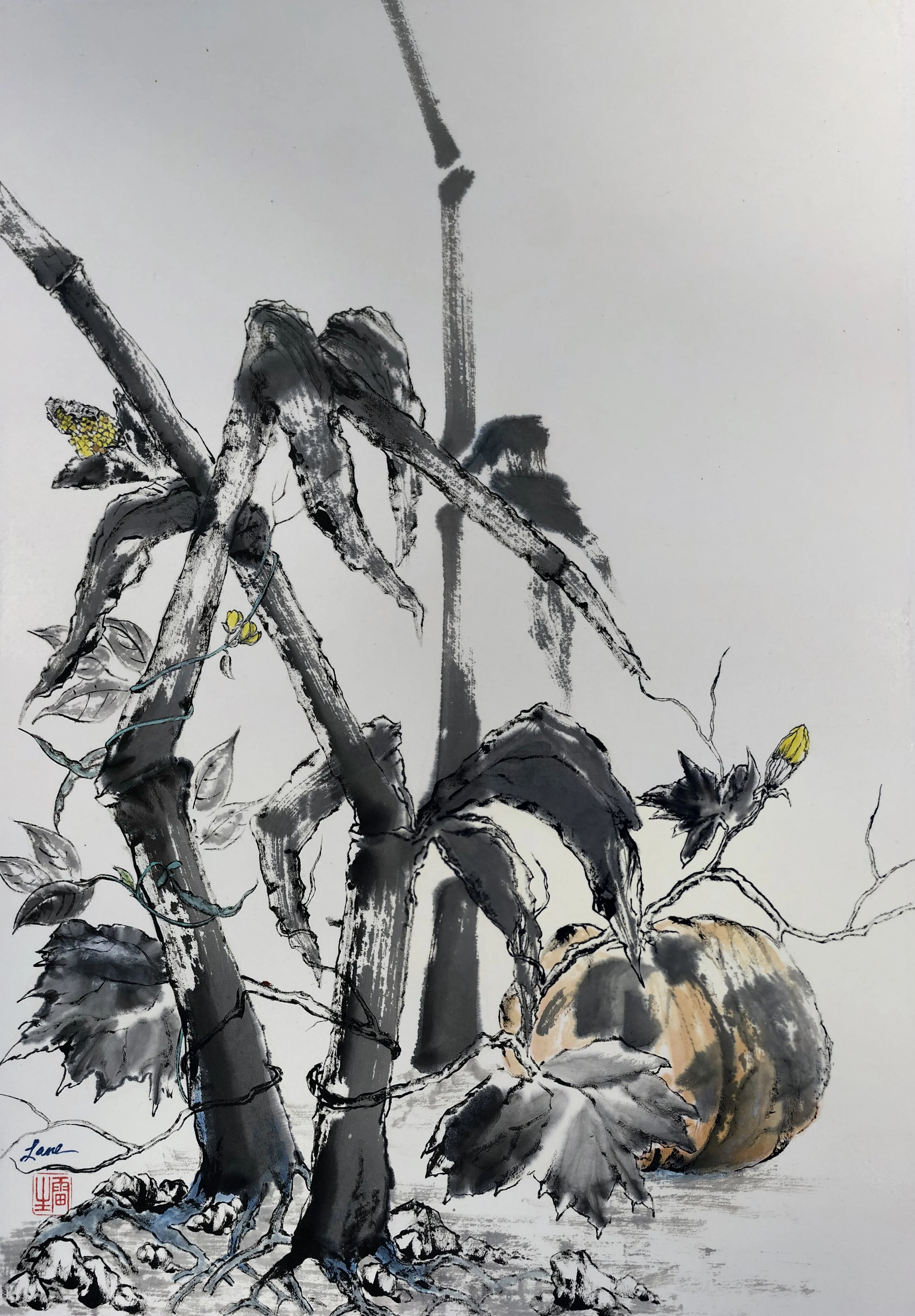
Looking for founational truths of ecologically responsible living, I came upon habits of inidigenous populations that work “with” the environment to achieve acceptable results as well as longterm viability. Native Americans embraced this advantage by planting three different veggies— corn, beans and pumpkins on the same plot of land. This humble agricultural approach accents, practically, the potential for mutually beneficial interdependence— the pumpkin leaves keep the weeds down while the corn stalks provide the trellis for bean stalks to reach the light. Metaphorically, this painting suggests that today we will be wise to recognize our interdependence with the land and man’s creatureliness shared with all other things. This is the local wisdom that still remembers where food and sustainable flourishing come from.
“Indigenous Wisdom”
Artistic Vision
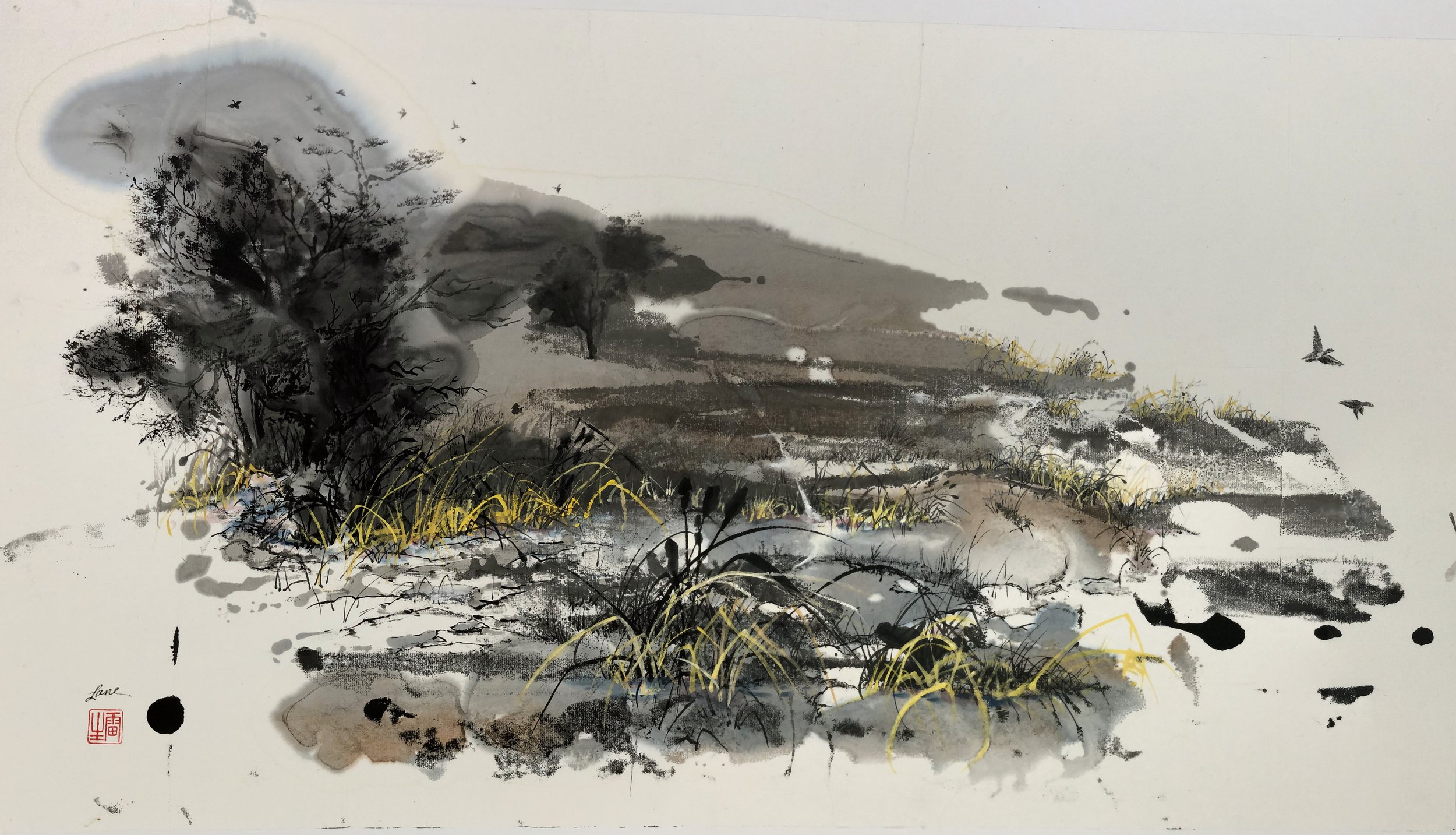
Assessing the past is one way to open the door to thoughts about the future. For years December and January have been devoted to combing through the past 12 months for directive hints about the next 12. Below are two paintings that have recently attracted comment and awards — “Morning Stirrings” and “ Holding at the Edge".
Similarities between the two include the techiques i.e., launching with a pour, ink brush line work and shaping, mapping shadow and depth through dry and side brush techniques as well as the messaging that is also similarly focused on liminal marshes, spaces magically and simultaneousy framing transformation and transition.
Will this continue to be my jumping off place for meditating on the Designer’s uniquely crafted plans? We’ll see…
“Morning Stirrings”
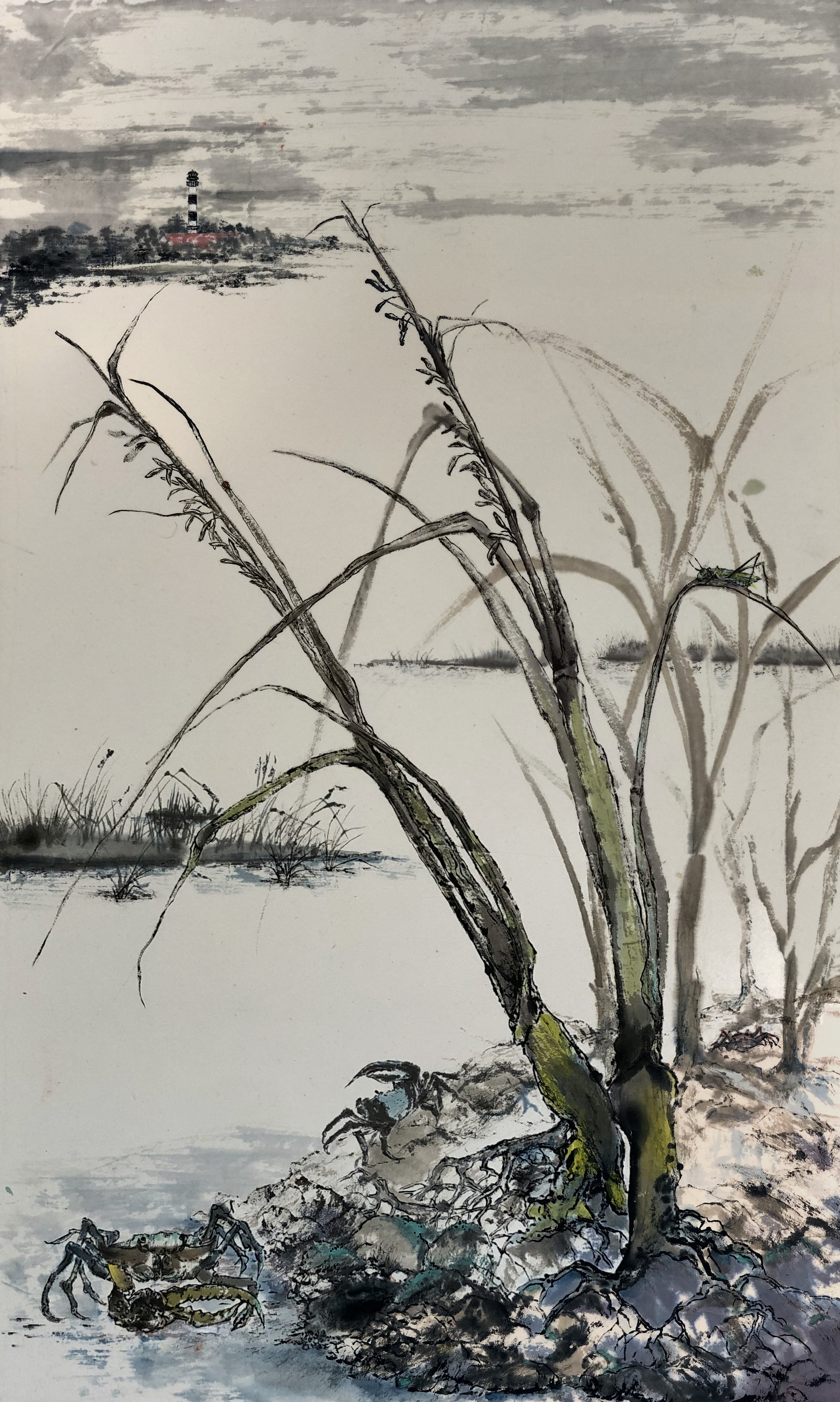
“Holding at the Edge”
“Time: The Straight Stretch Between the Two Bridges”
This expressionistic painting about “time” was inspired by C.S. Lewis’s description of time as a straight line.
“If you picture Time as a straight line along which we have to travel, then you must picture God as the whole page on which the line is drawn. We come to parts of the line one by one: we have to leave A behind before we get to B, and cannot reach C until we leave B behind. God, from above or outside or all around contains the whole line, and sees it all.”
C.S. Lewis Mere Christianity

How majestic is your name!
This painting is part of a collaboration with Josh Poe, a singer-writer in Virginia Beach who recently was inspired to write a song about Psalm 8. My painting is a partner with his musical creation. Verses 3 and 4 of Psalm 8 grabbed my heart and inspired my piece. Here are those words penned by King David:
“When I look at your heavens, the work of your fingers, the moon and the stars, which you have set in place,
what is man that you are mindful of him, and the son of man that you care for him?”
It seems this is one of the main questions for me and perhaps for any person. In light the incredible expansive creation, what is my place and purpose, and what can explain God’s interest in my life?
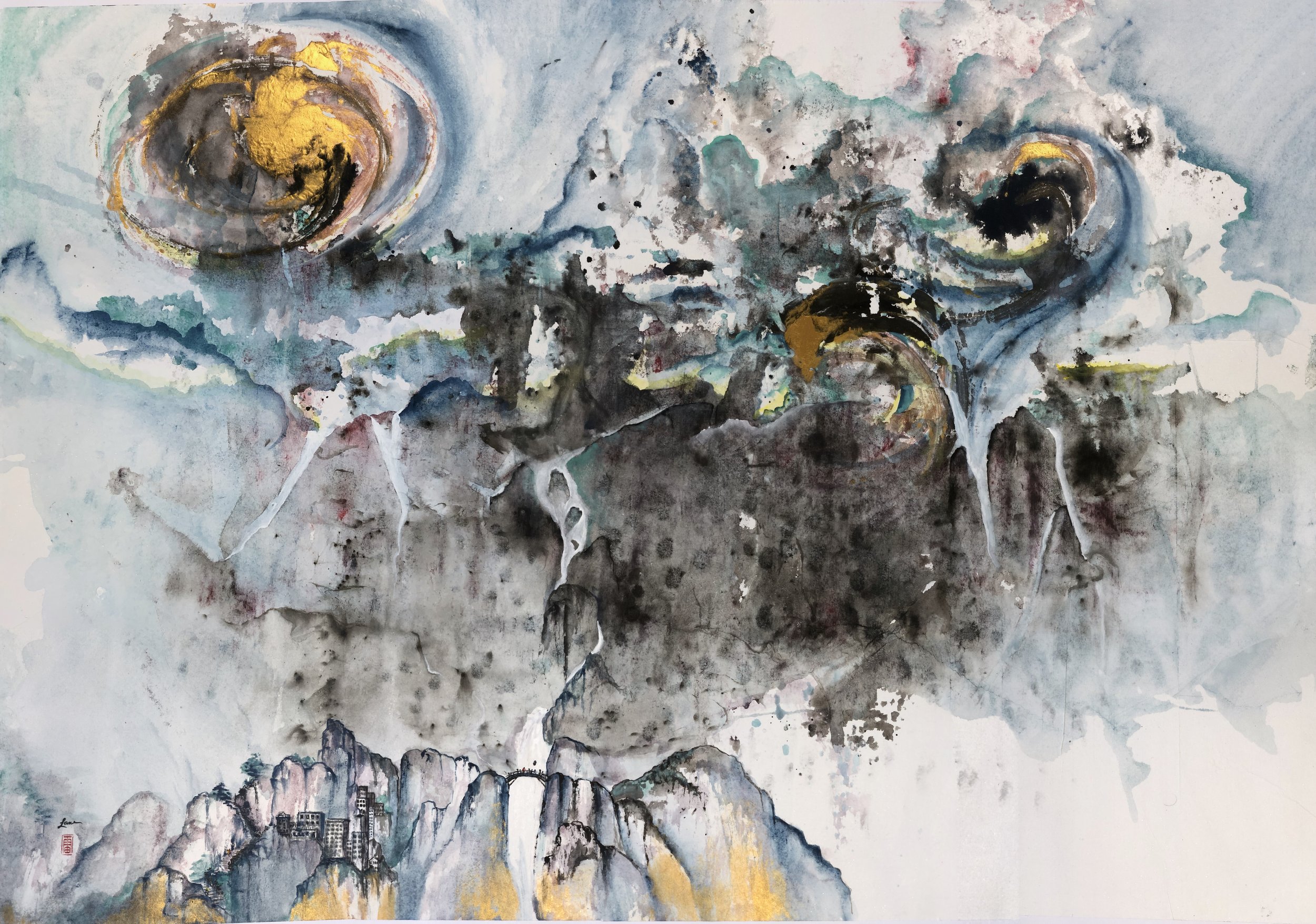
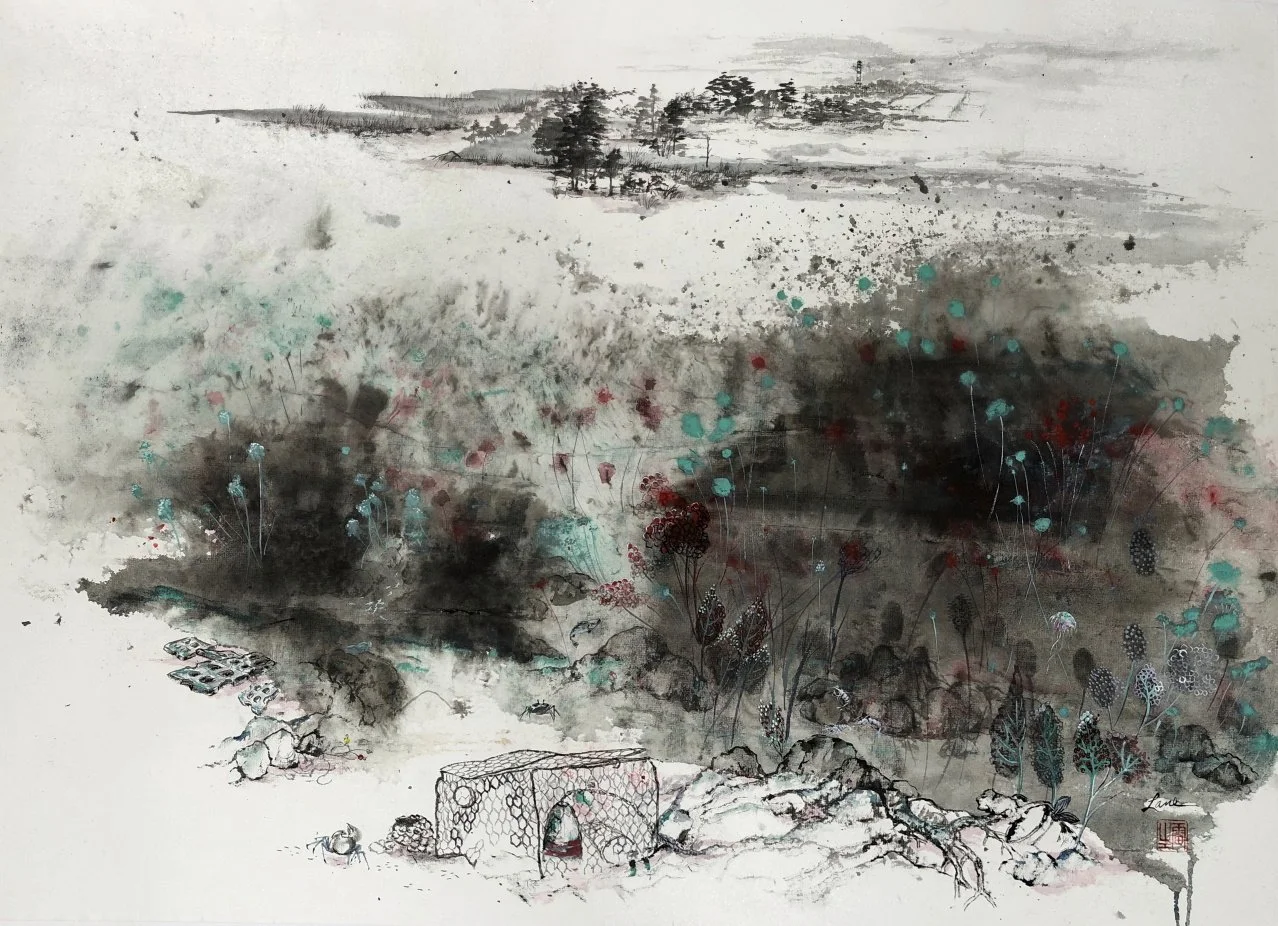
Smoky Ink on the Water
“Smoke on the Water” is a pour embellished with brushed ink and watercolor on sized (“shu”) suan paper. The water tends to puddle on this kind of surface, and the pour created sort of an inky mess. In the early moments of the process nothing penetrated or connected with the fibers of the paper. I decided to rub off some of the pooled liquid, and as it thinned and spread, it reminded me of smoke dissipating into space. The next move was a little counter-intuitive. I took the inky surface, now dry, as a metaphor for pollutants in coastal water environments and used a fine brush to build out the narrative within and around the troubling scene.
Messaging in the work includes environmentalist concern for the interplay between fisheries in the foreground and farming in the background. You can see the Mattamuskeet lodge tower (in Swan Quarter, NC) in the distance because treatment/use of the land and the use/treatment of the water, their interaction, has been a long standing tension in this village community. My mother’s family comes from there and so I feel especially connected and concerned about the dilemma.
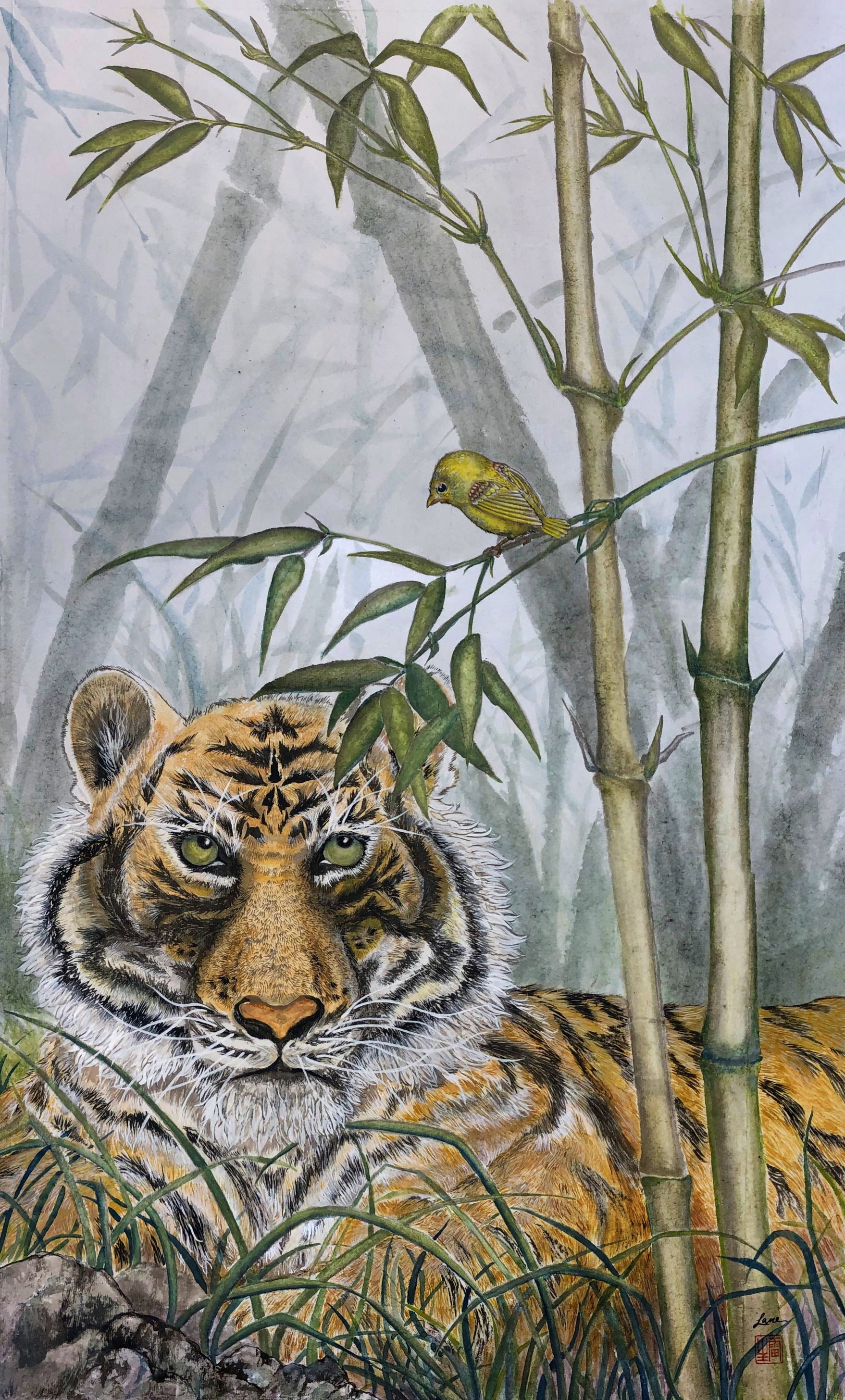
Note on Year of the Tiger
I just completed this meticulous (“gongbi”) styled jungle scene yesterday. This sumi-e technique uses two brushes simultaneous and focuses stubbornly on the details through many layers of the painting process. Gongbi is known for taxing the endurance of the most patient of painters. Usually, I know when a gongbi work is near completion when I begin to hate the process, and I’m tempted to make finishing the highest priority.
The Year of the Tiger is the space on the Chinese 12-year cyclical calendar that celebrates those whose birthdays fall after the year of the rat. Impetuous, powerful, brash, these tiger-ish folks must thrive in today’s world, it would seem; so, traditionally tigers have been associated with protective courage and endurance, yin (female) strength, and show up on boy’s baby shoes, and the clothes of generals and hunters. However, my use of the gongbi style in this painting messages something a little different. Brush strokes present individual hairs and whiskers of the tiger and the micro-down on the juvenile bird perched above his head. This attention to fine details declares the magnificence of the Designer’s mind and His purposes and understanding that penetrates every minute part of human experience.
The painting narrative includes a yellow bird. No, not Tweety, though the idea-worm has already entered my mind. The little guy surveys the tiger and occupies a place of honor, just as much as his massive neighbor. One might say, they are visiting as equals, learning, engaging, but not threatening or cringing. There is almost something Edenic about the scene. Best wishes to you during this Year of the Tiger!
“No Stopping Place” was created to highlight the joys of a long upward trail. The gold of the pour spoke to me of the riches along the way that balance the weariness of the ascent. Yep, I’m speaking in both physical and spiritual terms. The title comes from the lyrics of an old mountain gospel tune— imagine banjos, a washtub bass and a shrill Appalachian drawl— “there’s no stopping place, no stopping place. Through faith in God, I’m saved by his grace. We must o’rcome ole Sat’n ‘til the end of the race. In this warfare there’s no stopping place.”
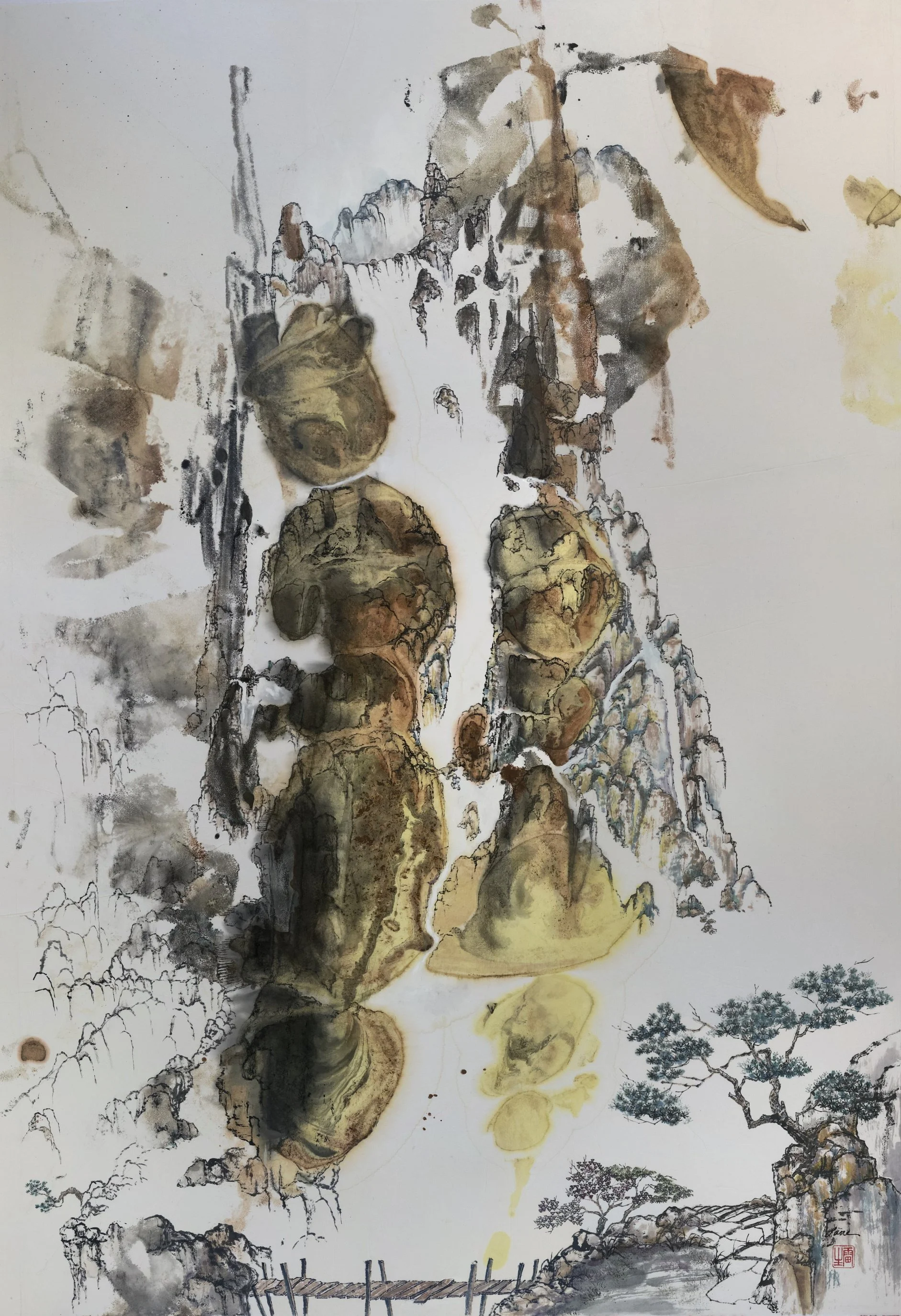
Swamps and Sumi-e
Sumi-e artists throughout history have gained much inspiration and passion by focusing on their individual locales. Famous sites as well as the flora, fauna, and cultural artifacts associated with them are celebrated specifically or as composites from particular areas-- whether that be a Li River karst landscape, a farmer harvesting cabbage, children playing with crickets, or a path and pilgrims hiking up a mountain. Imitating them, my artistic vision and journey have led to celebrating local landscapes on the East coast of the United States. To a great degree, this means focusing on marshes or swamps, as they are sometimes referred to; for example, we are home to the Great Dismal swamp in Virginia and Swan Quarter’s Lake Mattamuskeet in North Carolina, places rich in history and folklore.
Some might say asking onlookers to “enjoy” the swamp landscapes might be an uphill battle. For sure, swamps are stereotypically viewed as dangerous, stinky, and evil…sinking sand, as they say. “Drain the swamp,” a familiar phrase these days, carries this negative connotation. That said, marshes, in fact, are the spaces where life begins and is sustained for many creatures. They are buffers that protect where the collision of the energy of the sea and inertia of the land negotiate and balance themselves. Pools and shallows are hiding places being just chaotic and unpredictable enough to level the playing field for prey and predator alike. Many species in the food chain find the key to viability there and some, like the oyster, give back by purifying waters that feed systems at the most basic level.
My opinion is marsh art may have a place in helping us formulate new reasons for environmental conservation. I’ll quote Curtis Badger (Salt Tide, 1993) to respond further: “We’ve been taught in our culture to avoid marshes and swamps…People distrust places where the footing is not always solid and reliable. We like dependability and certainty; we like what to expect when we put our feet down…. Such attitudes, still widely held and perpetuated in our culture, helped to bring about the destruction of hundreds of thousands of acres of marshlands in America in the last century.”
Marshes are the border zone where water batters the land and the things of man, taking back earth to be hidden beneath the flood surge, and it is rain water running away from the higher ground, energetic rivulets returning through creeks back to the ocean. In this way they buffer and protect. Marshes then are not smelly places to be avoided or “filled in” by construction teams, but a complex, and yes, sometimes smelly transitional blessing, a liminal paradox—both opportunity and destruction nest there in the dynamic edge of things.
There is a spirituality to this massive transformative adjustment that happens continuously along our coastal borders. Looking closely at the changeable water’s edge woven tight with cordgrass and cattails, it seems to vibrate as the roots of an old cypress lose their grip and the branches topple over into the flooding creek. This end for the old tree is actually fortuitous. Falling into the water, it may make a new area where the water moves more slowly, creating a shallow and then a new fertile bank that welcomes new seeds, new grasses-- a new edge.
How does this work? Suspended solids in the water fall to the bottom as the waters slow (because of irregularities along the bank) thus forming an eddy, a swirl or bar. The faster moving water nearer to the deeper part of the water course move to the opposite side cutting away at mud and soil. The result is the natural formation of a curve. These “s” curves, where the water finds balance as it flows against one side and then the opposite side of the channel, are the dynamic creek bed, but this meandering form can be an aesthetically pleasing metaphor for the swamp that finds its winding way towards buffering and mediating opposing forces—land and water.
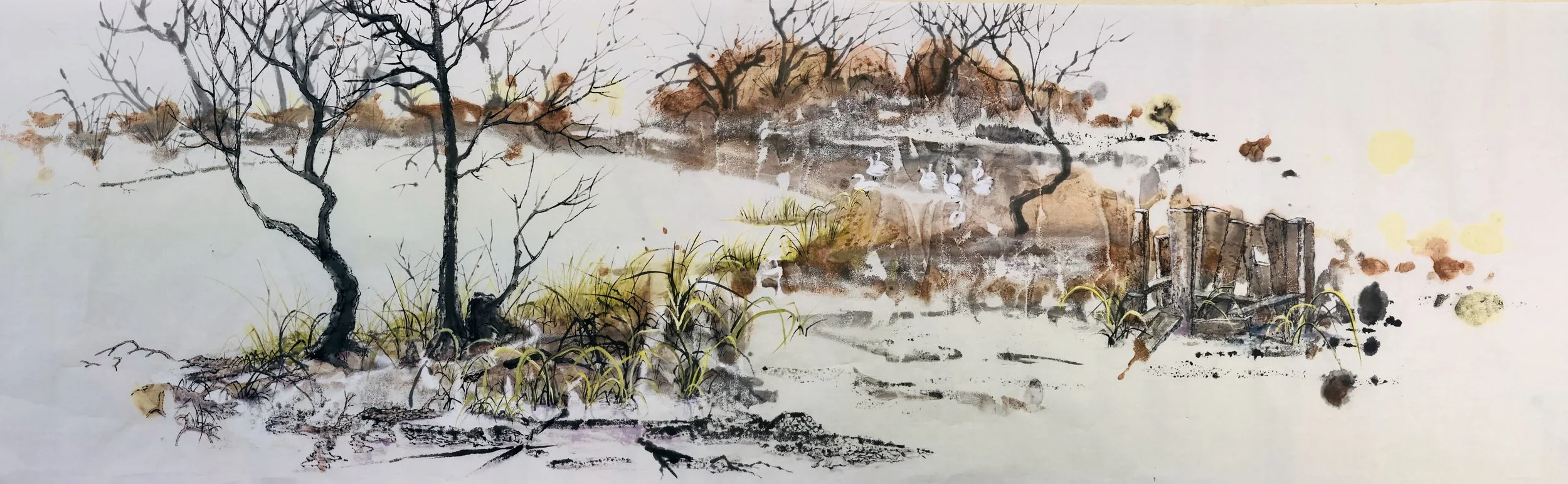
A Blue Feeling
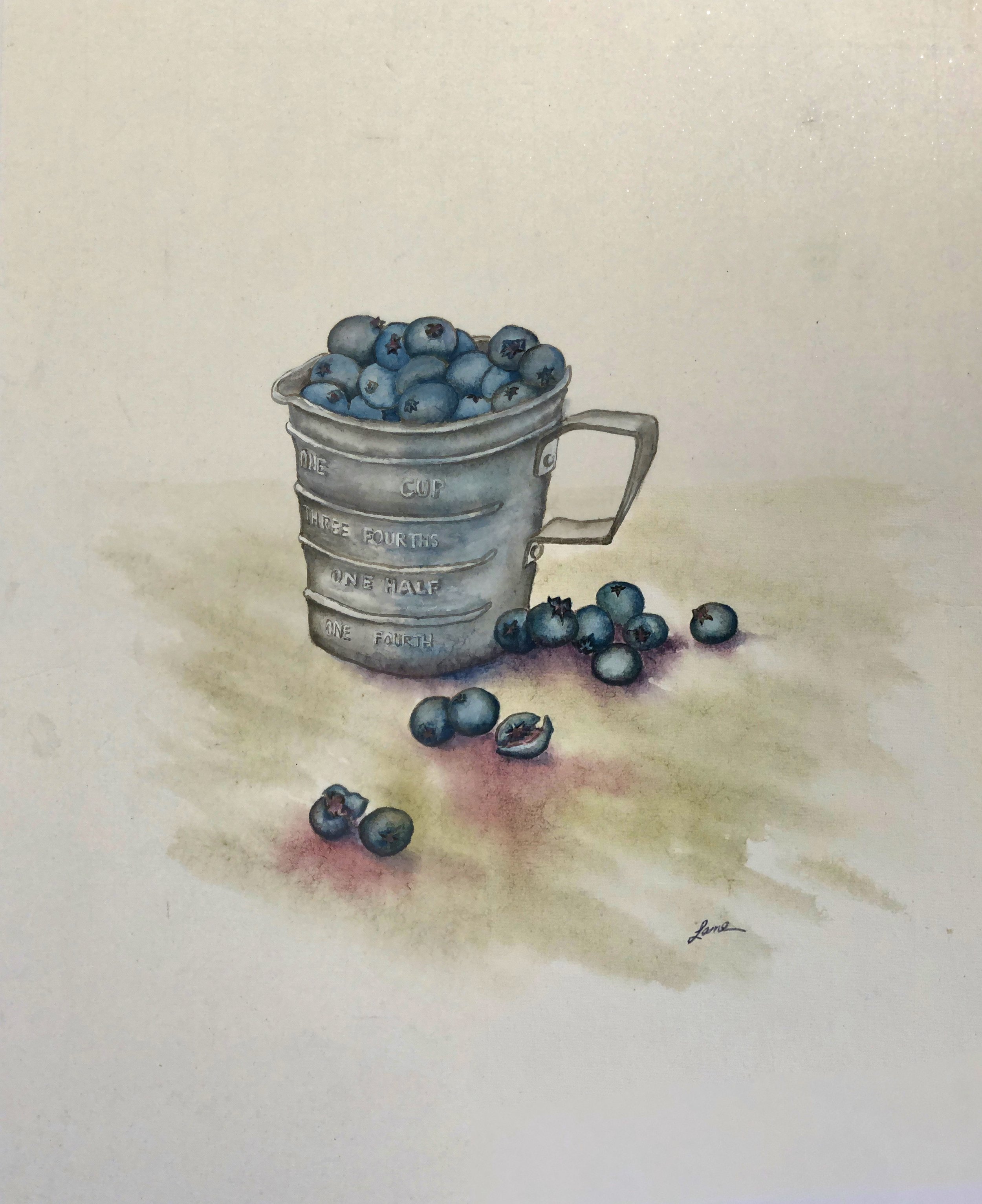
Recently I have been preparing several paintings for the “In A Blue Mood” show at the Virginia Beach Art Center. The piece with blueberries in a vintage measuring cup highlights country life of by-gone days and a focus on the good things families and communities experienced when living close to the land. As Wendel Berry often has pointed out, big commercially driven farming has dislocated us from the land and distorted understandings of interconnectedness between soil, water, plants, and people. Agricultural accomplishments when exclusively measured by quantitative understandings— volume of crops and reduction in the number of people needed to bring them to market don’t come close to a full description of our current situation. In recent years, something has been gained with increased yields on large farms, but something has been lost as well. “Preserving Blueberries” urges us to be more careful to adopt a viable holistic view of land use.
Thanks Gallery 21
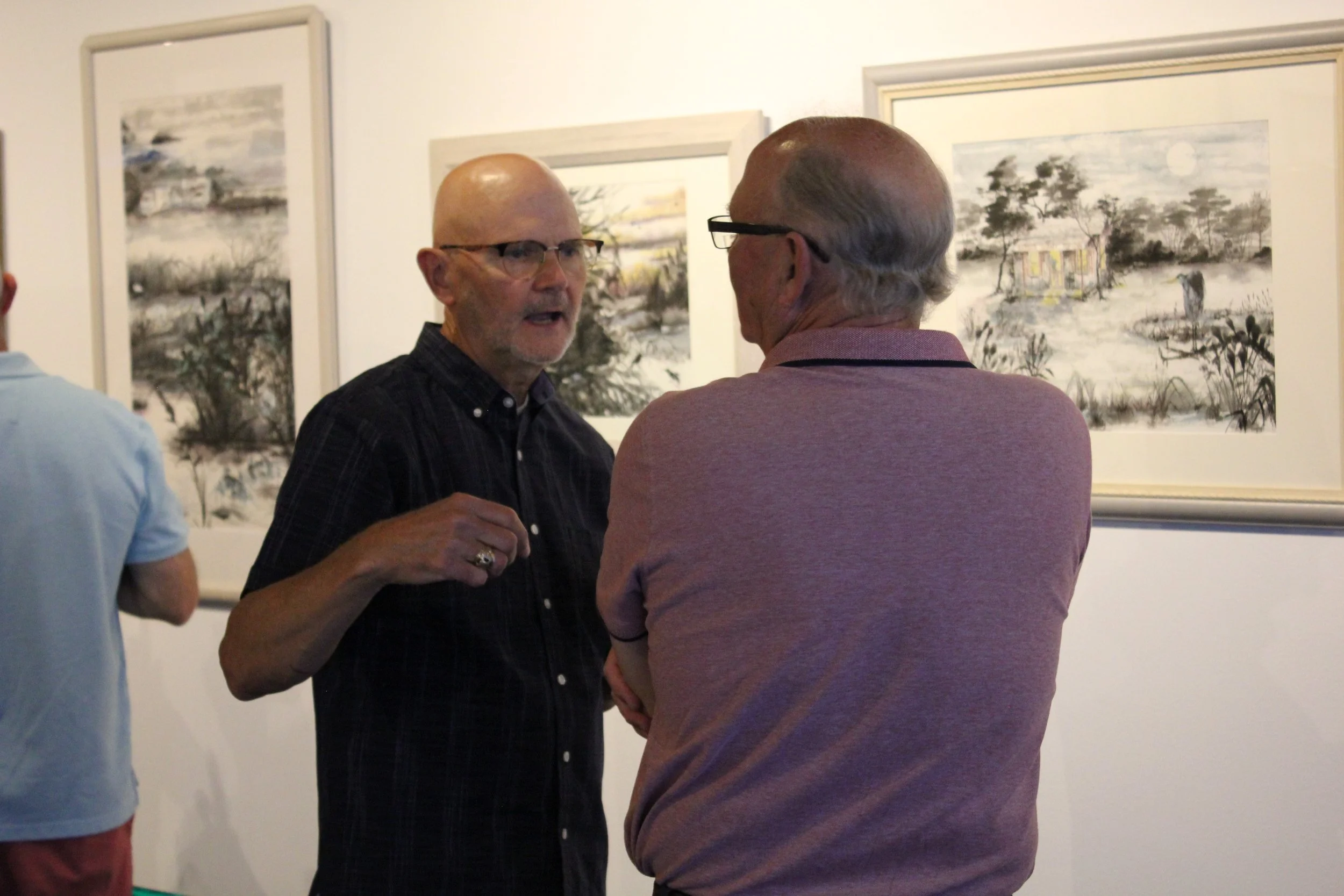
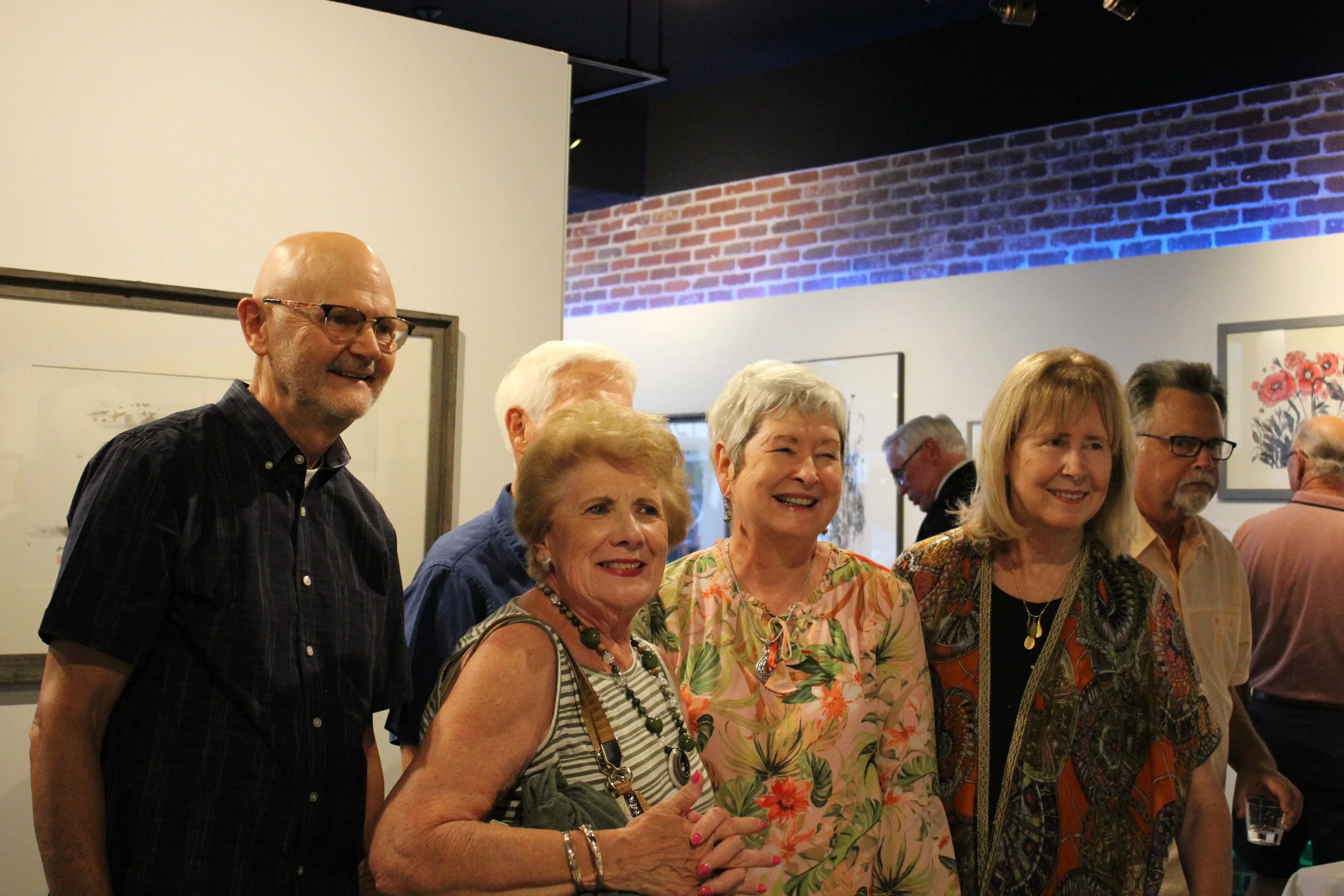
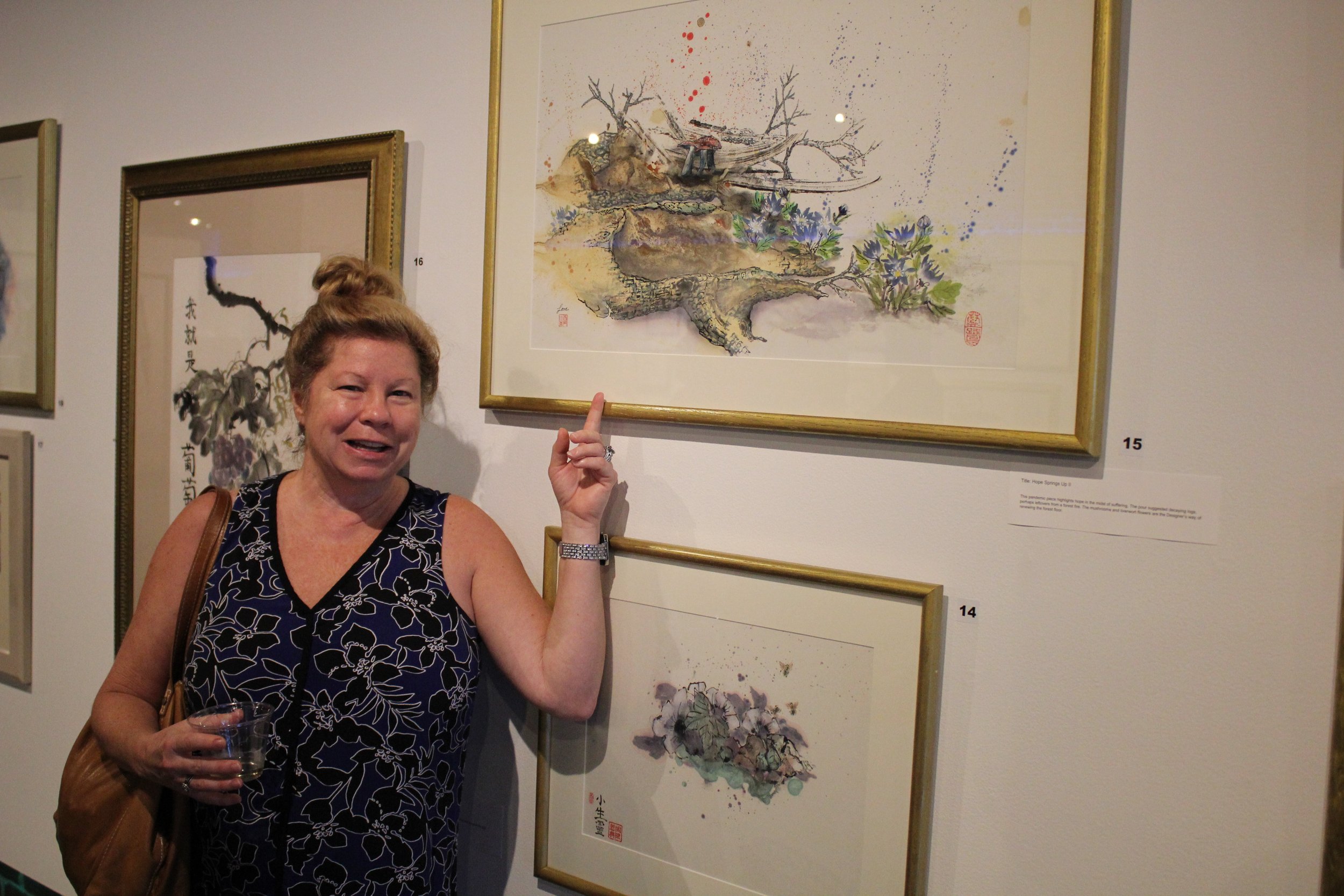
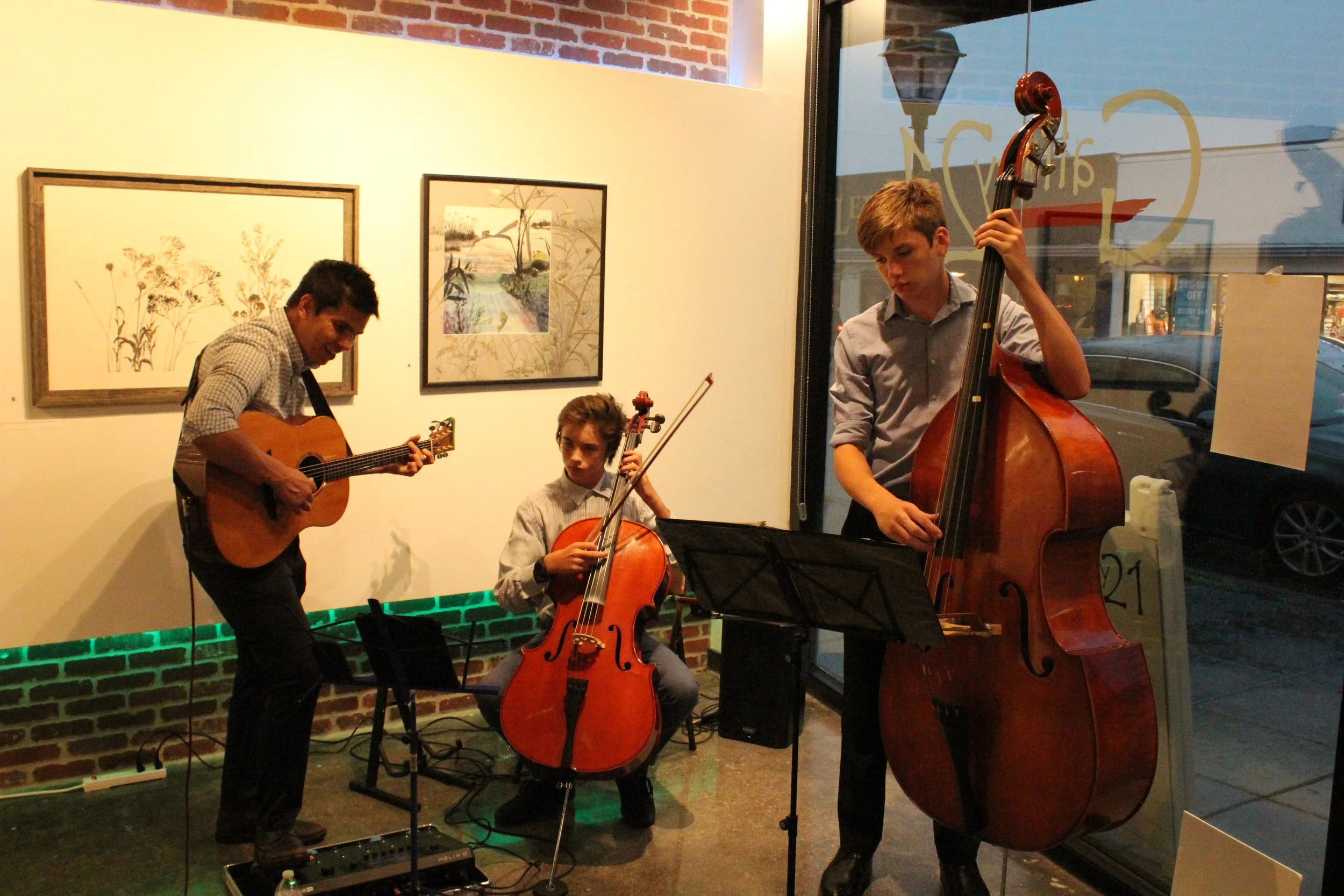
Running August 15-September 18, my exhibit at Gallery 21 in Norfolk, Virginia, was a unique window for viewing 75 paintings that have signposted my path as an artist— all hanging in the same place and time. It felt not so much as a journal describing the past but a map for future. Many, many thanks Jim & Darlene, John, and Susan. Also, many thanks to the Esperat “Band” and those friends and art lovers who showed up at my reception on such a stormy evening.
Strength of Trees
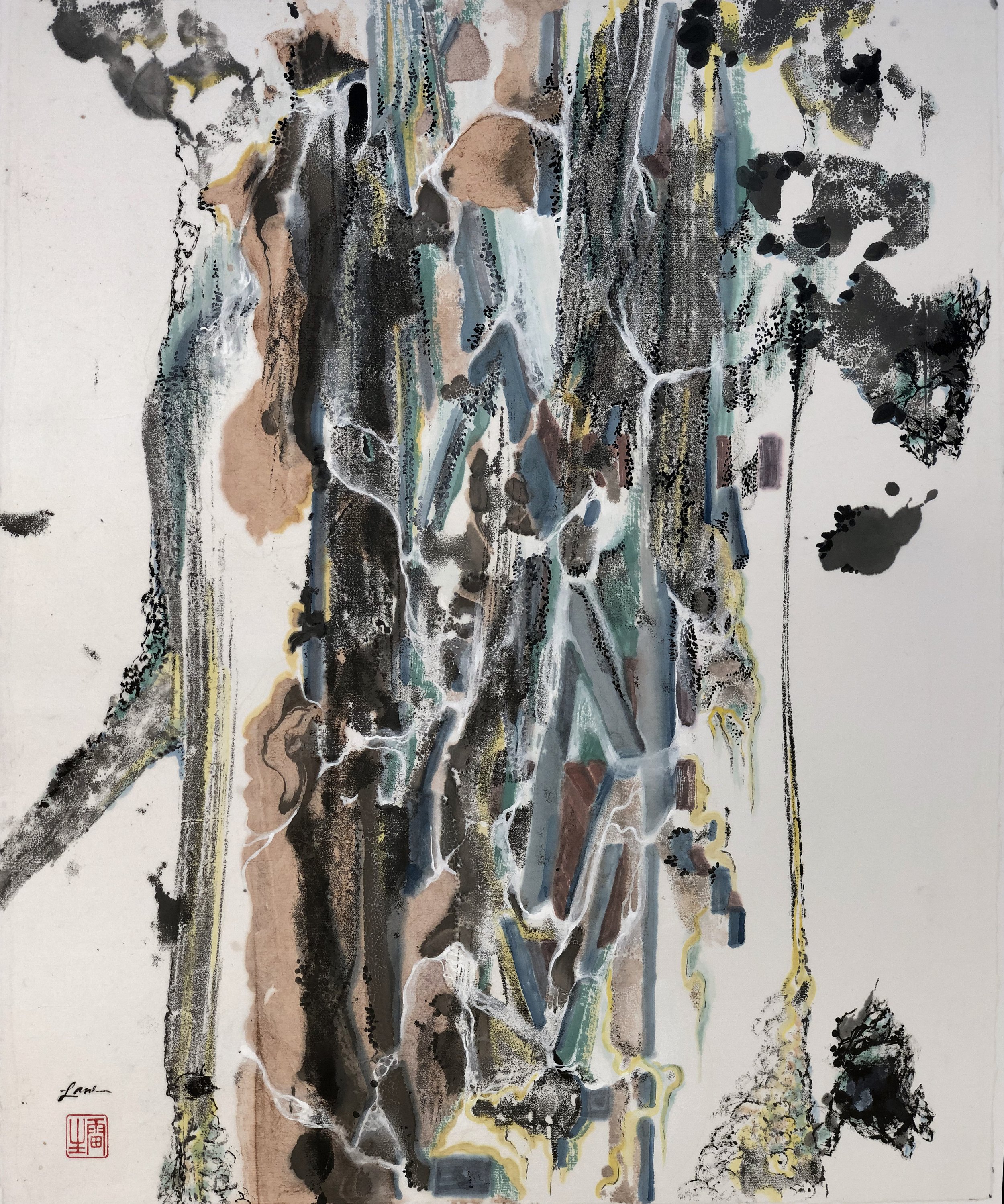
I am drawn to trees not because they provide me with flowers or fruiting branches but because of the stories they tell, in the map of color and crevice at their core, where they attach to earth and water and stone. This is the strength of trees, their firm resolve and their promise of accessibility and flow. The vertical presentation of this abstract celebrates this strength. The horizontal perspective in the second visual below speaks to me about respect and reason for care, for the future and the ways of men among trees.
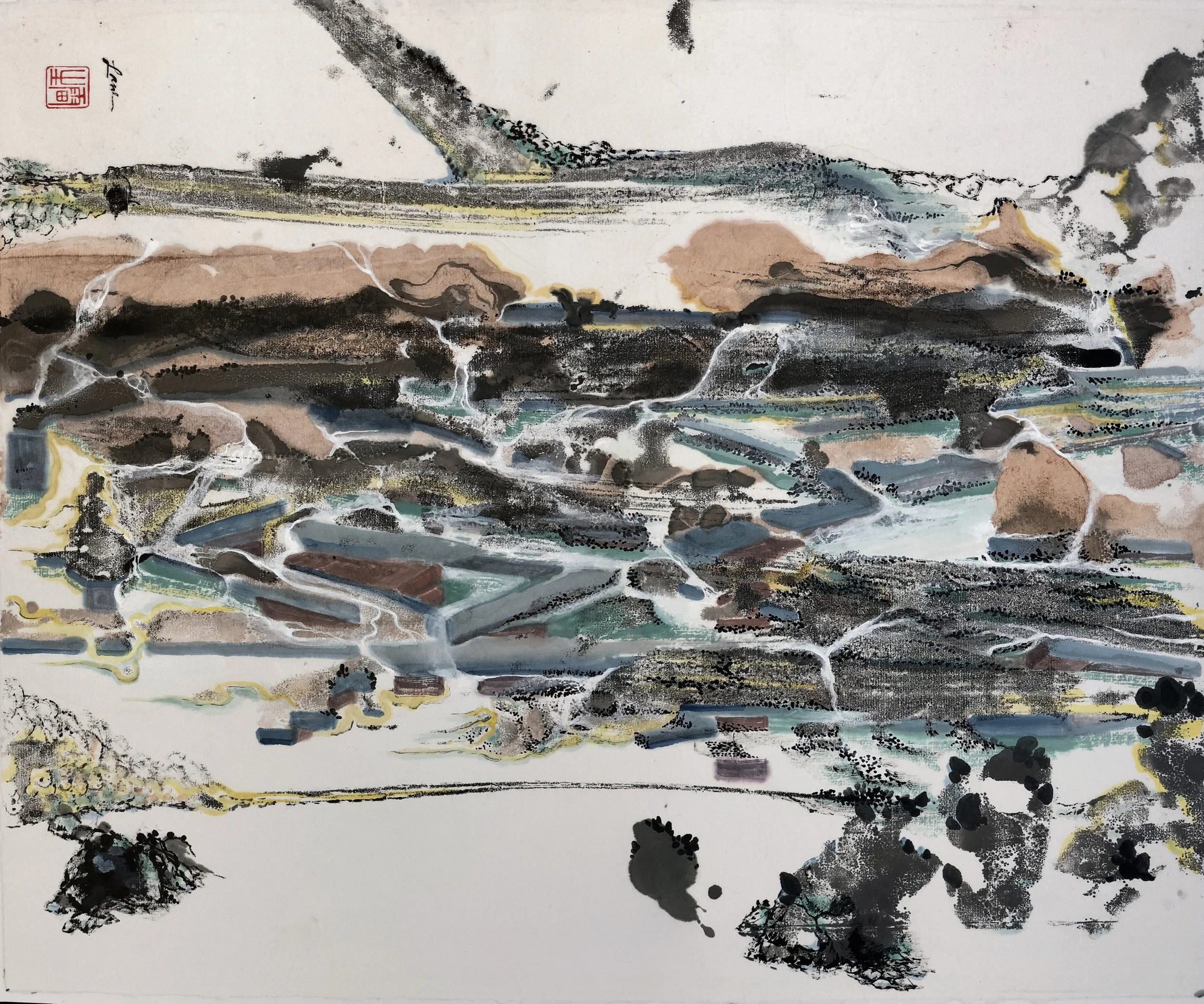
Conversation Piece “50th HS Reunion”
“50th High School Reunion”
“Sui Han San You” is a traditional sumi-e theme that features three plants that thrive in the winter—bamboo, plum, and pine. This trio symbolizes friendship and its strength and vitality in times of adversity and ultimately, in old age and death. Traditionally, the composition is usually crucial for achieving a balance between the three as they show up close together in the same painting.
This work, as the title indicates, takes a comic turn from the traditional concept displaying a plum tree that has a strong root system but has grown old and rotund. The spindly arms accent the huge trunk that seems to be missing a top that has perhaps been hit by disease or perhaps blasted by lightening. All that said, the blossoms are beautiful, but just in the wrong place. The pine tree enters from the top in a somewhat aggressive and annoying way perhaps suggesting that it is still the “tallest of the three.” The bamboo on the left, known in its youth for strength and flexibility has grown brittle, and the lichen covering the surface is in a way beautiful but indicates its weakened state. The one precious thing they all do still have is the most important thing--their friendship-- which is indicated by the way they lean into one another, as if taking a selfie.
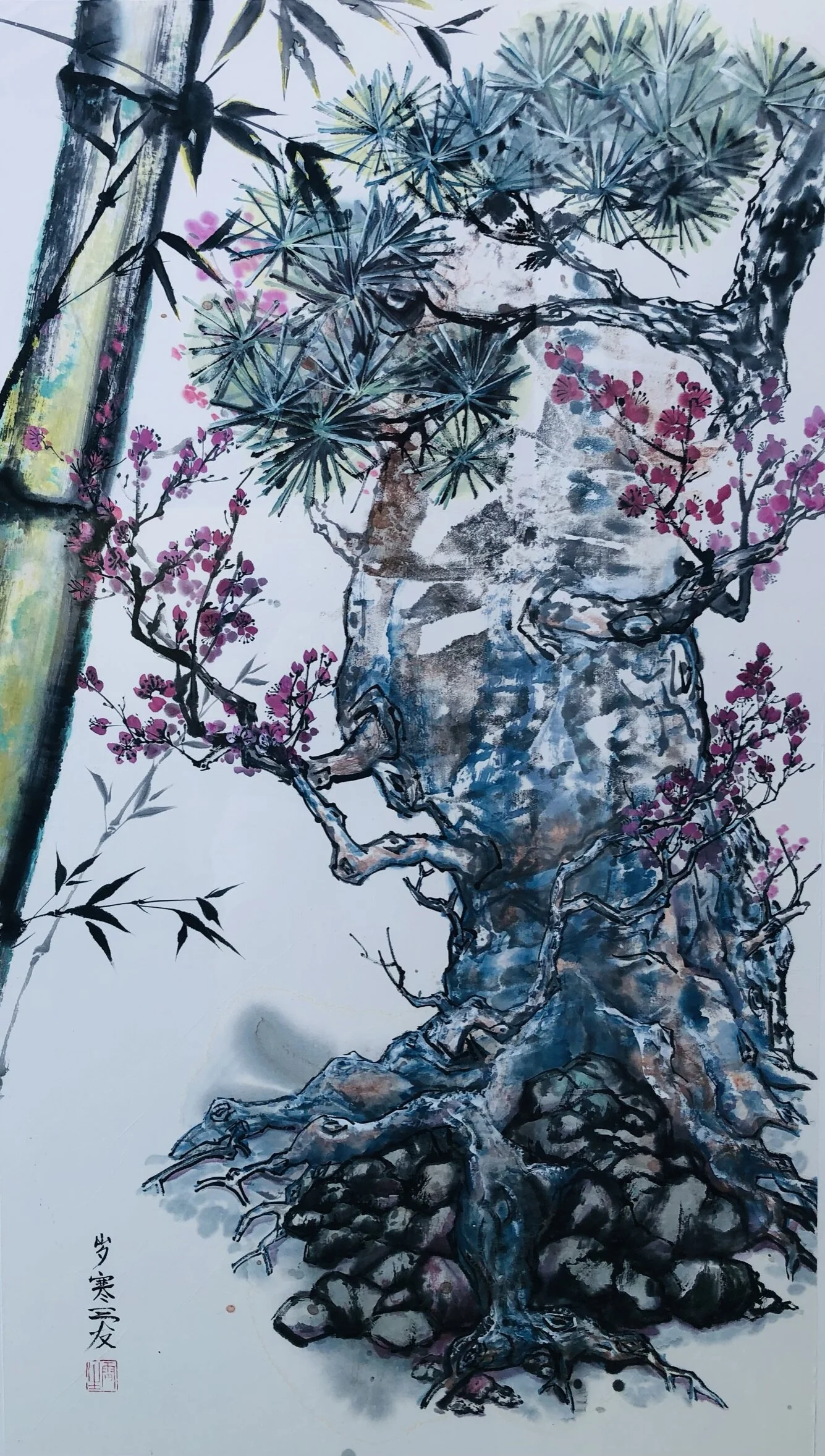
8 Sisters
At a bend just near West Neck Marina there’s a spot I call the “8 Sisters” — 36 deg 41’ 36.3’ N / 76 deg 2’ 30.0’ W. I like the place because the root ball of a fallen cypress shows its liminal power to launch new opportunities— for grasses and flowers to inhabit formerly uninhabitable space. The surrounding vertical trees, the other “sisters,” testify to this truth about coastal dynamics.

What’s Next: Pours Up Close
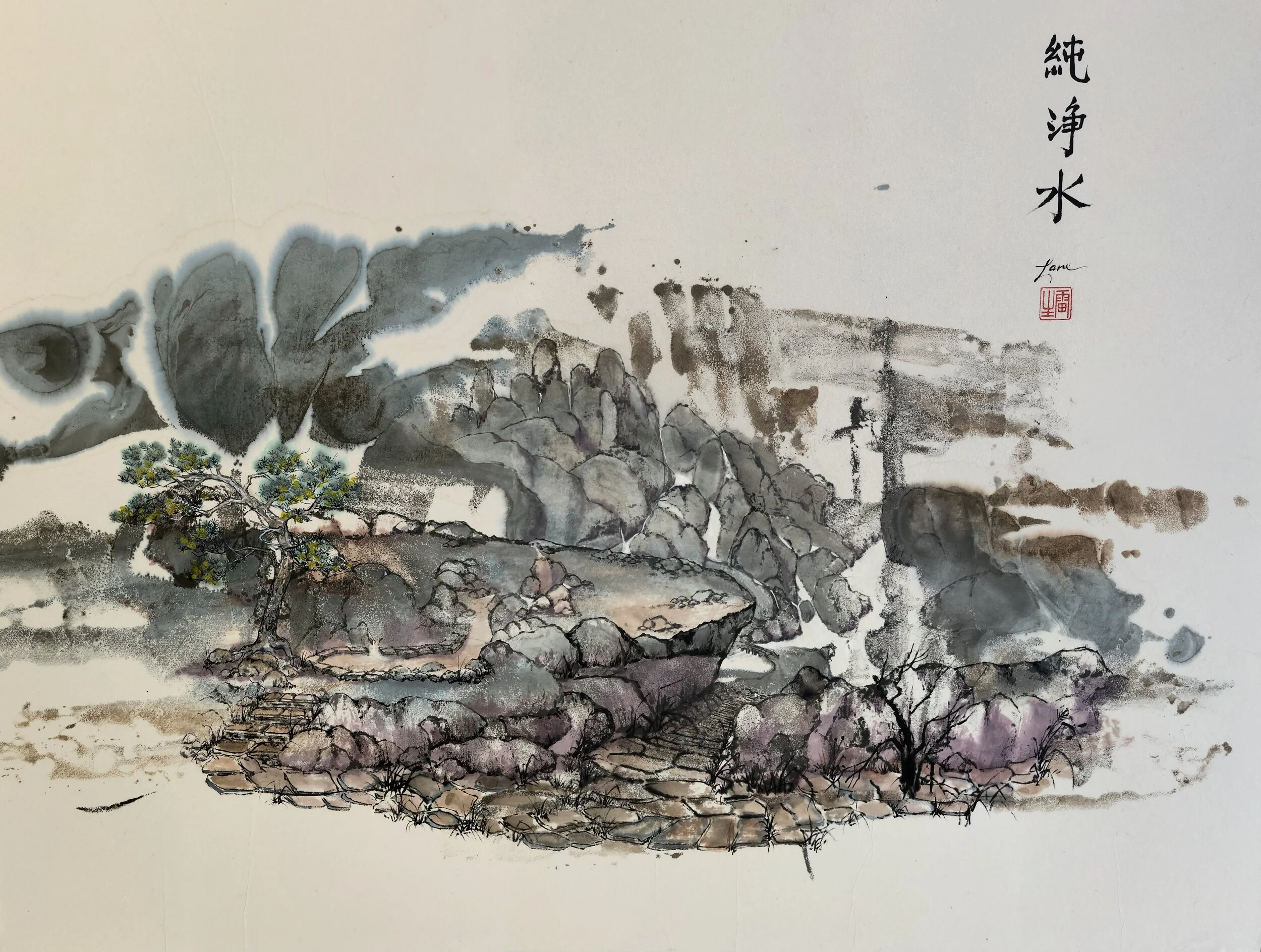
Recently I have been thinking some about my “what’s next” now that Covid and all of its social and emotional restrictiveness seem to be abating. This, somewhat surprisingly, has been a little frustrating partly because new exciting ideas, motivating vistas and guiding vision haven’t just immediately materialized in my old brain. Why? Maybe Covid has made me lazy. During the pandemic, the parameters of my art were narrow and always buffered with abundant excuses for why I wasn’t pushing to envision the future. My inner voice just urged me to hunker down and help myself and others maintain a healthy waiting pattern. In fact, I actually experienced a lot of creative productivity during the pandemic, and fell in love with pours, their spontaneity and emergent quality seemed a perfect metaphorical backdrop for the uncertainties of the pandemic. Also the “sub-creating” and “world making” of landscapes within the movement of the pigments really provided a safe and satisfying flow state in my isolated and secluded studio. Pours became sort of “therapeutic” and addictive, and now I find myself being pulled back into doing more pours (which I love) but find them less compelling, there is a nagging feeling I should be doing something else. “After a Rainy Night” and “Pure Water” are fun pieces that carry the energy expected from an emergent pour but also some of my anxious waiting for newly engineered post-covid vision, my “what’s next”.
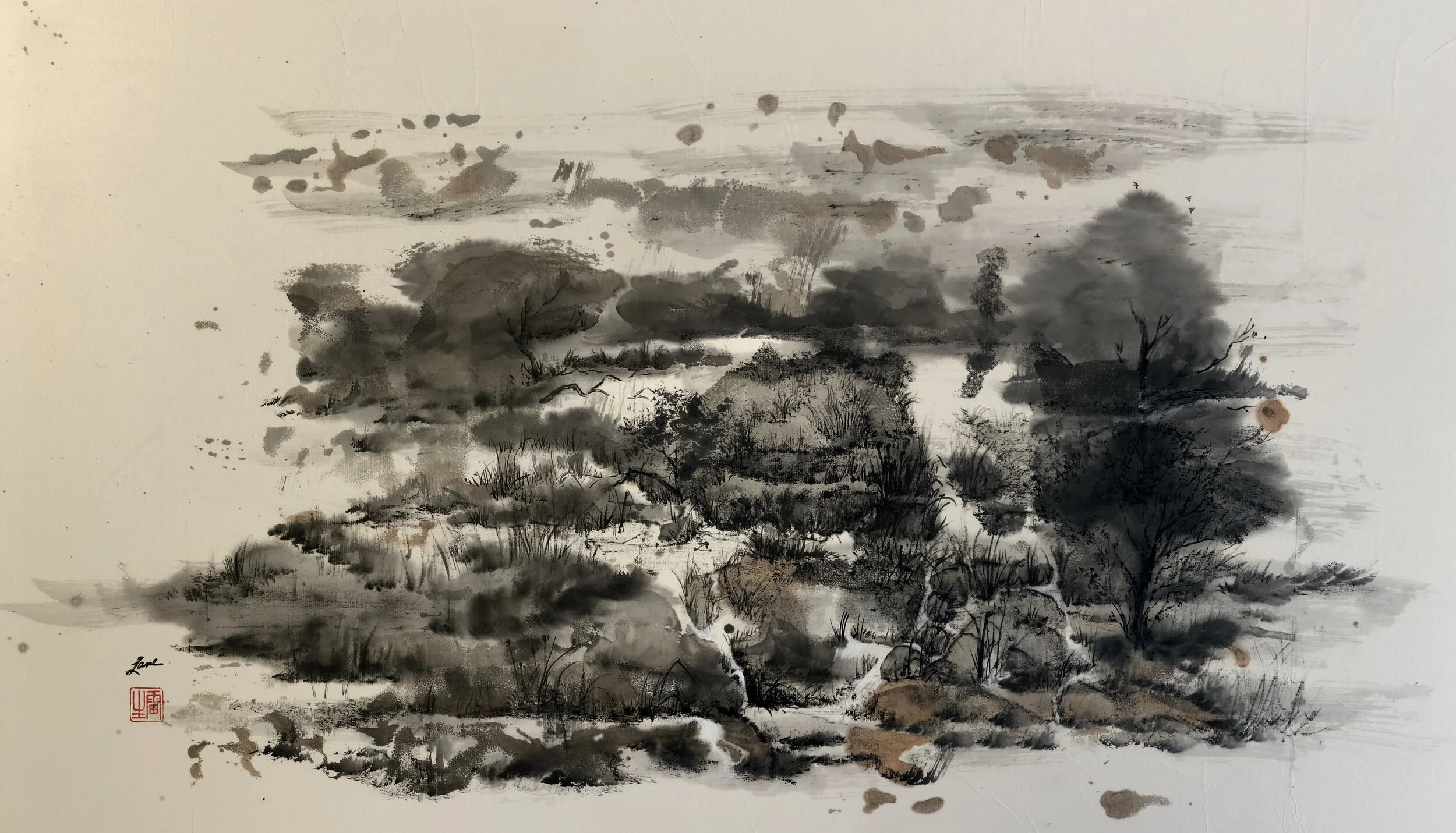
“After a Rainy Night”
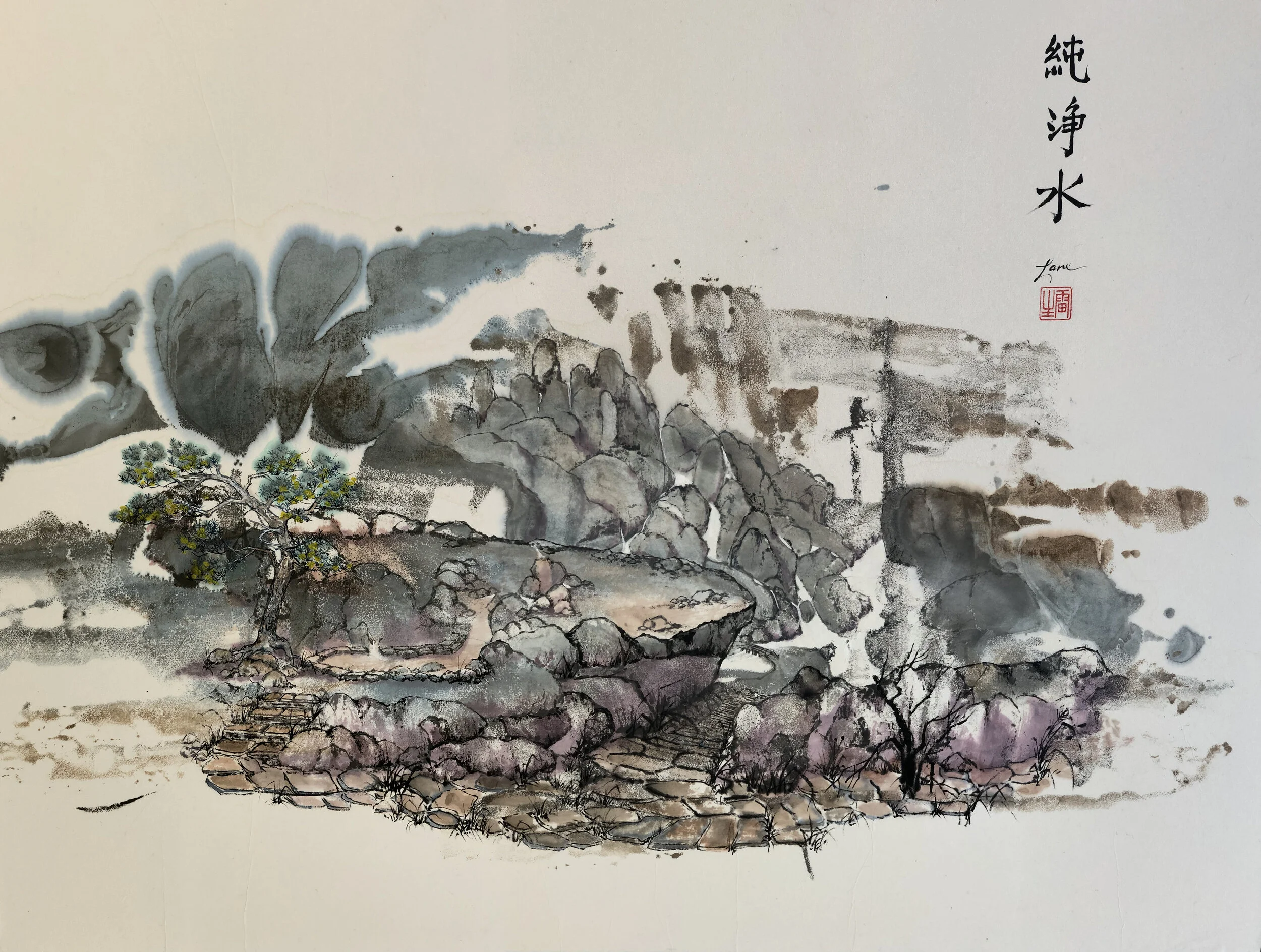
“Pure Water”
The “Long Version”
On March 11th, I was given an opportunity to explain my artistic journey to Rob and Sandi at the Meyera E. Oberndorf Central Library in Virginia Beach. Monthly, they interview and record a local artist for their Youtube “Meet the Artist series.” I dread recordings, visual or audio. They just usually haven’t ended well for me. It always seemed like as soon as the record button was pushed, all of my nervous tics displayed and fanned out like the tail of a peacock, thus obliterating any hope of “coming across right.” However, let me say again, however, this time was different. My messaging wasn’t perfect of course, but somehow Rob and Sandi put me at ease, I got lost in the love of art and explanations flowed for almost an hour. If fact, it is difficult to remember having such a generous audience and space to just walk though the long version of “why art” in my life.
Anyway, my recording will be available on Youtube on April 7th and I welcome you to give it a look and a listen— “Carolina Sumi-e” I’m calling it. A recent painting, “After A Rainy Night,” displays this mix of Carolina coastal sentiments and sumi-e style. The link is https://www.youtube.com/channel/UCthFY1kbs-z2e-mEuBjOnhA.
Pure Water
It is settled. I confess I’m addicted to what J. R. Tolkien and C. S. Lewis called “sub-creation,” i.e., artistic “world-making.” Lewis and Tolkien believed they found pleasure in creating their fictional worlds because they were emulating, in some small but significant way, the Designer who made THE world. This pleasure, sometimes also called inspiration, sometimes “flow,” satisfies, like a drink of pure water. It is the feeling of doing what one was made to do and in circling back to beginnings, signals completeness. “Pure Water” accents the worth of the walk up the mountain to get that drink.
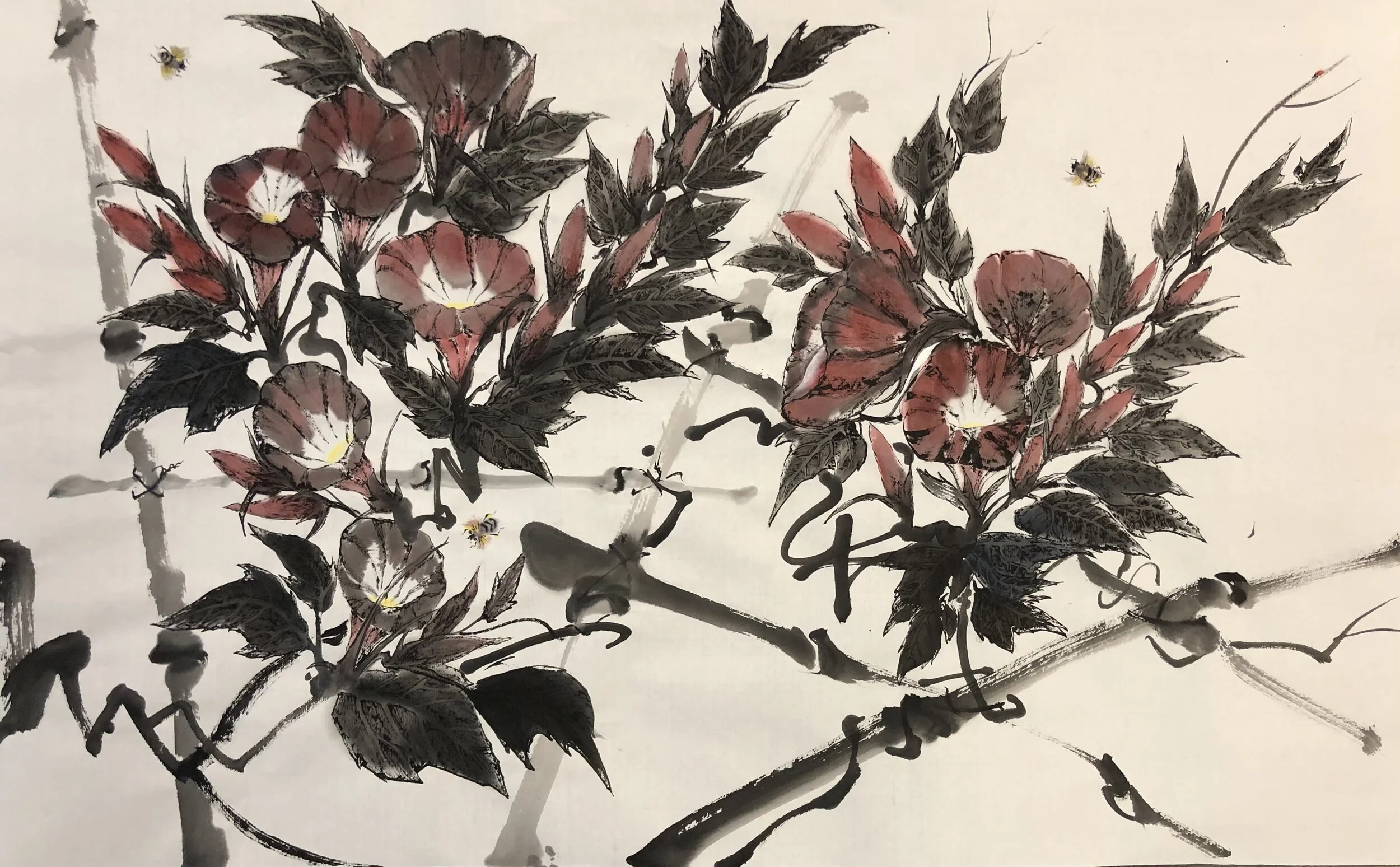
Morning Meditation
In the same vein as the previous post about the delicacy and vulnerability of beauty, these morning glories are given a hyper-real, almost stone-like presence. Man has planted them but their statement belongs to the Designer.
How Many Petals Have Fallen?
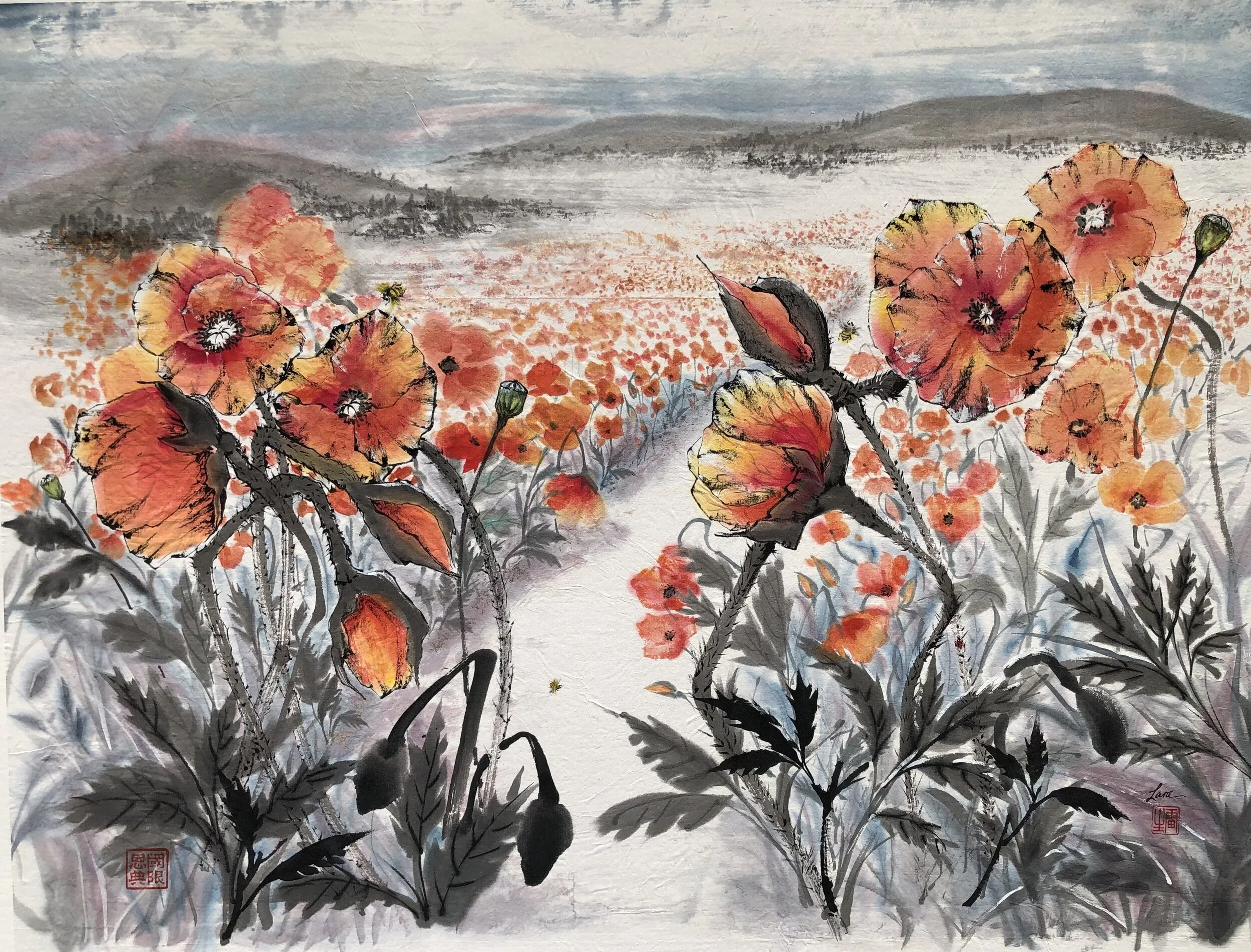
Recently, flowers have been my focus— their beauty, irresistible, undeniable. Let’s face it, everyone on the globe loves a flower. In meditating on why this might be, I have come to believe that one of the reasons their beauty crosses all cultural boundaries is their vulnerability to ruin. Chun Xiao explores this aspect of flowers in the well-known ancient poem, “Spring Dawn.” He is lying awake just before sunrise, and remembering the evening storm, he wonders how many petals have been blown off the flowers in his garden. This thread of thought reminds me of how delicate the balances are in our world. I want to be grateful for this precarious beauty and the One who holds it together. This painting of poppies develops a tension— brilliant color to reveal their delicate nature and an adapted dry brush stroke to accent the stone-like power of their beauty.